Preliminary second-gen warm-air intake observations
On the first half of this year's long holiday trip, I have gained a little
more insight into the steady-state effects of the warm-air intake in the
Prius, in part confirming the previous year's observations that it makes
almost no difference at all on the highway.  In this case, I was able to
see variations of WAI effect in midrange temps around 45F, in which this
particular implementation apparently works too well and brings IAT quite
high. The Prius engine management compensates for either configuration and
in non-extreme conditions, seems to burn about the same amount of fuel to
get there.  All that remains is to consider any remaining factors in overall
HSD efficiency which may have minor effects on actual FE.

Consider the sweet-spot discussion, exploring methodologies for running the
engine in its most efficient band over varying terrain.  This is basically a
measurement of relative injection duty cycle, starting as the engine begins
producing meaningful torque around 70 Nm and trying to stay in an "overdrive"
situation at low RPM, helped by MG1 being motored backwards to seesaw speed
across the PSD and drive the output ring gear faster.  In normal highway
travel without big hill climbs, it's generally possible to stay within that
high-torque, low-RPM scenario for good efficiency.

What the WAI does is cause less fuel to be injected per cycle to make up for
the less-dense intake air.  But this also means the engine produces less
*torque* at the same throttle opening.  So to get the same propulsive torque
at the wheels, what has to give to make up for it?  The power equation,
torque * RPM.  The engine at lower torque must therefore increase RPM through
a different effective transmission ratio, and thus the same amount of fuel is
burnt over a given distance.  By swapping the WAI on and off and changing
nothing else, I can observe a definite shift in the sweet-spot range *because*
the injection duty cycle changes.  WAI off, more torque, lower RPM range for
the same drive force at the wheels.  WAI back on, less torque, engine revs
higher at the same injector duty and the HSD must make up the difference.
What the latter means is that MG1 comes out of "heretical" or "reverse split"
mode sooner, the valve timing retards under less accelerator demand, and it's
more difficult to stay in the "overdrive" mode and still maintain speed.  This
meter is sensitive enough that I can actually see the rich/lean fuel-trim
transitions in closed-loop feedback if I hold my foot rock-steady, so I
could definitely see a difference.

It's also *much* harder to hold warp-stealth with really high temps coming into
the intake.  There may be a direct relationship defined in the ECU between IAT
and how much demand causes the engine to re-light, but I also saw that the
battery SOC seemed to sit a little lower in general.  On some of the uphills
I was running up to like 2900 RPM out of necessity, *way* out of sweet-spot
range, and noticing that a little bit of battery current was being brought in
to help.  In other words, the system had likely figured out that the engine
was less powerful now, and began making up for it with electric assist sooner
in the game!  Once the SOC drifts down toward 55% or so, the warp-stealth
accelerator-position "plateau" drastically shortens.  The only way to maintain
it is to hold the battery current around zero, which is a much more delicate
foot-feathering operation and is a bit more distracting to have to eyeball the
meter that much.  When sailing down a long hill, that's not necessarily the
best practice.

The overdrive range-shift with the WAI in place seems to hang into somewhat
inconvenient territory at the highway speeds I was doing, and may have a minor
impact on overall system efficiency.  As engine RPM increases at a given speed,
MG1 RPM drifts up toward zero.  Now, because of the PSD, MG1 has to take up
any leftover engine torque that's not getting to the wheels.  In heretical/
overdrive mode, it acts like a motor that's sort of fighting against the
engine, but to get the best overall energy transfer it must nonetheless fight
as efficiently as possible.  Take a look at this chart from one of the Oak
Ridge papers, showing combined motor + inverter efficiency:
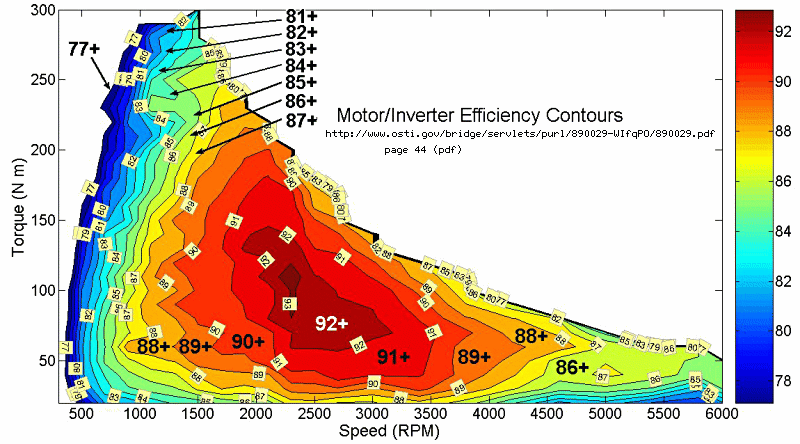
Motors have definite optimal peaks in their torque/RPM ranges just like
internal combustion engines.  Here, the inverter must also be taken into
consideration because in the Prius, at certain motor RPM ranges the inverter
goes to an "overmodulated" type of switching that is much more efficient
[fewer transitions] than straightforward PWM.  There is also a reluctance
torque component, independent of the magnets, that can only come into play
when the motor is spinning.  The combination of optimal motor RPM and load
and inverter switching mode contributes to how well that energy transfer
between the motors is done.  As MG1's RPM nears zero, this efficiency clearly
falls off, so it seems that it would be of some benefit to try and keep it
turning north of 1500 RPM or so -- in either direction!  Thus, having to
push the engine to an RPM range that causes MG1 to slow down too far likely
increases losses in the electrical path to a small degree.  With the WAI in
place in warmer ambient temps, engine RPM drifts too high too soon in normal
highway demand range.  Even with the valve retardation around 2200, the
engine's efficiency would probably remain pretty flat but the *overall* system
efficiency may be seeing a slightly negative impact from an "overused" WAI.

So it's beginning to look like the WAI needs to be dynamically switchable,
just like with those bimetallic warm-air flap mechanisms in the air-filter
snorkels of old carbureted cars, in a way that might be able to take outside
temperature into consideration and regulate IAT along some bellcurve of
how much it might help.  For initial warmup, full-on hot to help conserve
heat and build block temperature quickly.  For steady-state highway in all
but perhaps the very coldest conditions, just take in normal underhood air.
Exact changeover parameters are probably not that critical given what the
Prius engine does with fuel management, but it would seem worthwhile to allow
some driver control over its state that doesn't involve getting out of the
car and removing pieces of tubing.  A little butterfly valve with a servo of
some sort would probably not be that hard to implement.

This also carries interesting implications about what the highway "sweet
spot" RPM range really is -- it may turn out in the long run to be a number
of different and non-contiguous regions, depending on vehicle speed and
propulsion demand.  I imagine that I'll refer to the nomograph and experiment
a bit on the way back home with trying to jump across the low-MG1-RPM gap
and let engine RPM briefly go higher on hillclimbs, but still try to avoid
bringing in battery power.  Electrical-path inefficiencies may also be yet
another contributor to the nonlinear mid-speed MPG problem that many owners
experience between 42 and 55 MPH, but probably in a very minor way.
_H* 061218